With trembling hands, I held a manila envelope, thick and battered from some abuse it had suffered in transit. The return address told me this was more mail forwarded through my publisher. I stood frozen on the side of the road beside my battered old mailbox. I muttered a few choice curses as if words were spells that could ease my fears.
A thick blanket of white drifts reached up to my knees. Snow quieted the world: No wind nor even birdsong, only the hard thud of my beating heart. It was as if all of nature held its breath, waiting and watching.
To my left, my neighbor’s long driveway was unplowed. Their farmhouse appeared deserted and lonely. I strained to listen for any hint of company. Nothing. No car on the road, and not another soul in sight. Mercury County, Montana, was as silent as a tomb. Still, I couldn’t shake the feeling that someone was watching, gauging my reactions. A dangerous stranger could be watching me through a rifle scope.
Find out more about today’s Vocab Menace video postPHARO and PHAROS below.
In almost every interview with a writer, the interviewer will ask, “Where do the words come from?”
They’re always talking about “the muse.”
My answer is “My brain assembles factoids into narratives. Oh, and childhood trauma. Also, adult trauma. And….” Then I gesture vaguely around, alluding to all the nonsense that pervades our common experience. The news, social media, and falling down rabbit holes on Wikipedia provide plenty of raw material to construct delightful fictional conflict.
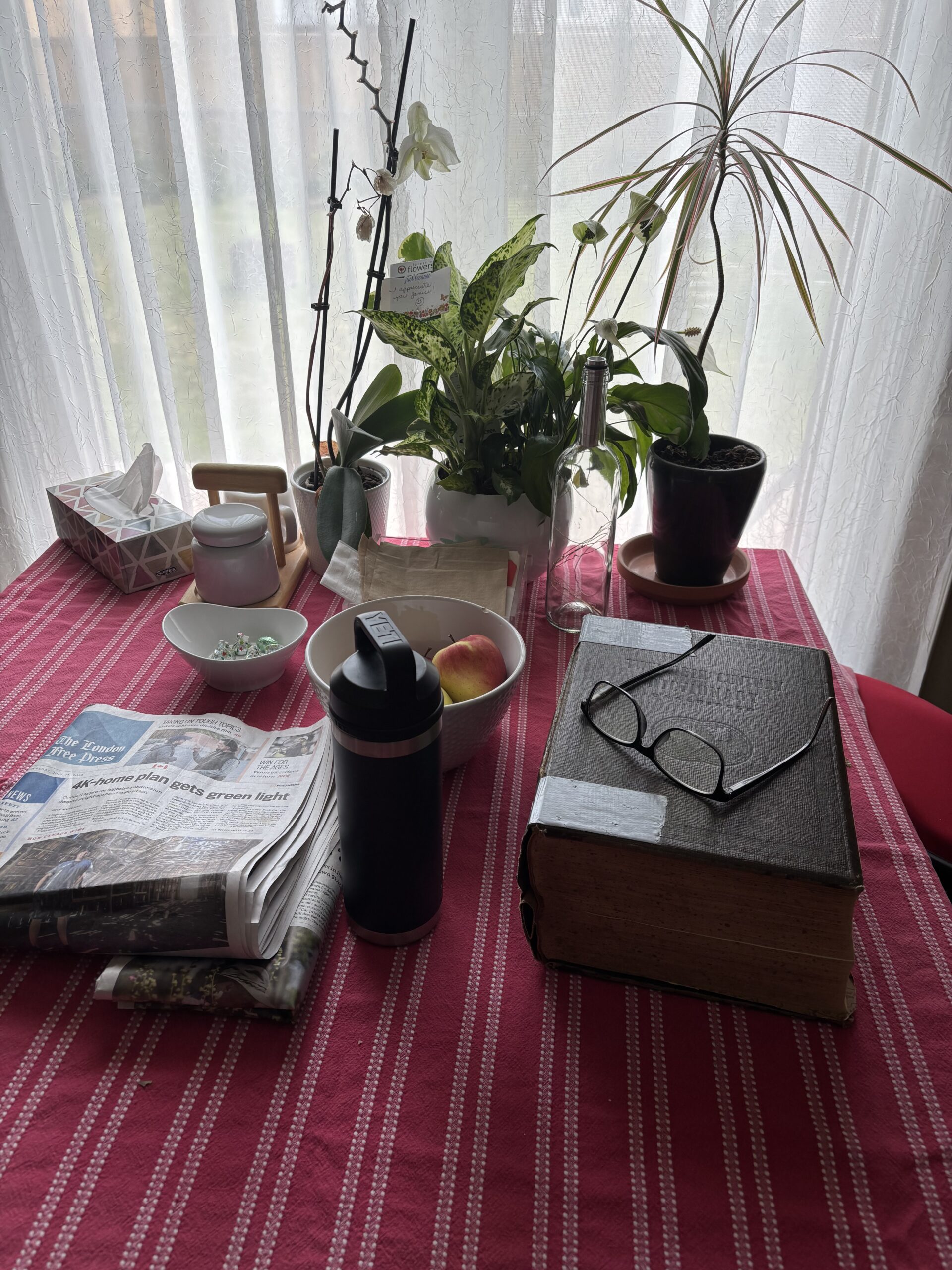
When I think about where words come from, I take a more literal approach. I own a huge Webster’s dictionary from 1939 (pictured). I forget how it came into my possession, but I’m sure it must have come from a library sale or used bookstore. This particular edition was the inspiration for Jaimie Spencer’s beloved dictionary in my apocalyptic trilogy, This Plague of Days. I had to apply duct tape to keep it from falling apart.
My kids have big vocabularies. Partly, that’s osmosis from growing up in a home packed and stacked with books. Also, we always spoke to them as if they were little adults. As babies, they were no doubt confused at times. Nonetheless, I figured they’d catch up and eventually understand my words and sense of humour.
Recently, I decided to make a video series out of my fascination with words.
It’s easy to post on social media with rabid urgency, “BUY MY BOOKS! BUY MY BOOKS!” Easy, but not effective. I’m always looking for new readers, of course. Every author is. However, I’m allergic to marketing. I do it, but I don’t enjoy it. Exploring the meanings of words and where they come from, though? That gets the happy neural juices flowing.
Vocab Menace was born.
Why call it Vocab Menace?
Words can be fun and interesting.
Your challenge each day is to slip these rare or unusual words into casual conversation as if it’s no big deal.
Imagine the satisfaction you’ll derive from all that simmering, smarmy, and artificial sense of superiority!
Like, subscribe, and share. All that stuff is sexy.
PLEASE NOTE: I’m away from social media next week (July 28-August 1).
I’m taking a deep dive into isolation to work on my new novel, but Vocab Menace will continue after that brief hiatus.
About today’s post:PHARO and PHAROS
In today’s video, I promoted Lighthouse Legaciesby Chris Mills.
Description:
Imagine living your life perched on a tiny island, without electricity, exposed to the fury of the sea, and always at the service of the mariner. This is how lightkeepers and their families spent their lives, even up until the 1960s. We are very close to losing the last of the people who lived this isolated life and experienced the heyday of lightkeeping in Canada. Lighthouse Legacies lets us share in the memories of those who kept the lights.
These stories are presented largely in the words of the people, with context and history by author Chris Mills. Each chapter deals with an element of lighthouse life and is complemented by photos from lighthouse family collections, the Coast Guard and Mills’ own collection.
I’ll soon pitch my next thriller to agents. I needed to expand my presence on the infobahn to appear everywhere with annoying rapidity. To that end, I’ve been writing on Medium. I have to admit, I’m having a good time with it. Plus, I’m on a couple of podcasts this week!
First up, the MMMM pod with my friend and author Andrew Butters. MMMM stands for Music, Musings, Moments, and Misfortune. Every Monday, Andrew posts about one of those aspects. I am his first guest, and ours was the fourth episode. (That qualifies as a Moment.) We had a great time talking about writing, reading, the worst thing I forgot, and the greatest frustration we share.
Next up: My interview with Buddy Gotton Pop & Prose!
This recording got hilarious fast. The subject is novelty songs. We came up with some good ones, a couple of horrible tunes, and two of my favorites.
Spoiler: “Hello Muddah, Hello Faddah” is my favorite.
This novelty song is my favorite, but Buddy and I talk aboutso much more! You’ll find us on Pop & Prose here:
Recovering from a nasty virus, I’ve had a lot of downtime watching the news. How unfortunate. As a writer of many apocalyptic scenarios, I’ve delved into how civilization in a multitude of ways. In Citizen Second Class, it’s a combination of class warfare, climate change, and financial ruin that brings down the United States. In AFTER Life an This Plague of Days, disease takes the world down. In All Empires Fall, there’s a range of narratives, from alien invasion to an asteroid strike. In Our Alien Hours, you guessed it! Aliens again. But the future is always surprising, isn’t it?Aliens, robots, killer AI and zombies are fun to play with. Paperwork issued by a glowering troll does not good fiction make. It sure doesn’t contribute to the betterment of the world.
When Donald Trump was on the campaign trail, annexing allies and declaring war on Mexico, Greenland, and Panama wasn’t on the table. (Don’t poo-poo or normalize it by saying he doesn’t mean it or that “he didn’t really blah-blah-blah.”) Fueled by anger and fear, President Petulance governs by spite and threats. Meanwhile, the world looks on, somewhat puzzled. His opponent, who proposed policies to assist people in buying their first home, was beaten by an adjudicated rapist and convicted felon who marveled about the size of a golfer’s putter.
The trouble with fiction is that it has to sound real. Apocalyptic non-fiction suffers no such constraints. For instance, the bishop who asked for mercy for the vulnerable in the gentlest way possible was condemned as “nasty.” As Stephen Colbert quipped, “How dare she bring the teachings of Jesus into a church!”
This morning I see reports of American citizens shocked that they’re swept up into ICE raids. Frightened of being abused and deported, many immigrant farm workers aren’t showing up to pick fruit. (Watch for a sharp rise in certain food prices soon. And no, eggs aren’t going to get cheaper.) Today, it’s reported that Native Americans are now being targeted by ICE because they aren’t “real” Americans. They say the concern is that indigenous peoples owe allegiance to their tribes over the American flag. It’s simpler than that, though, isn’t it? They aren’t white, and Christofascism is the order of the day.
There are many terrible changes and horrible possibilities on the horizon, but his followers don’t care. His allies abandon logic and their dignity to excuse every malicious move. What struck me most about the inauguration was that it was not a celebration of a great nation’s peaceful change of power. The tone and content was that of a coronation of a Christlike figure. With all the reins of power in his hands and a conservative Supreme Court bent on allowing just about anything, the United States is not unified. Trump may as well be a king, and he considers many of his constituents the enemy.He is not there to serve all citizens, just the ones who worship and/or flatter him.
This will all change, but not before many are hurt and victimized. Ironically, many of those who voted for him will be the first negatively impacted. For example, he has rolled back disability benefits for veterans and rescinded Biden’s executive order to lower prescription drug prices. He pardoned the J6 rioters who assaulted Capitol Police. I wonder how those assigned to protect federal officials are feeling about that this morning.So much for “Back the Blue.” If you were the officer whose eye was gouged out, how would you feel today?
I will not make a habit of chronicling Donald Trump’s offenses here. You can get that elsewhere in abundance. Mostly, I will sit back, wait, and watch. I am powerless to do much about the future of the world. It’s going to be a difficult four years. Anytime empathy is devalued, we are all diminished in myriad ways. I will say that DJT is a thin-skinned person, a soft and lazy man. He has been propelled to his position because he terrified of appearing weak. His cult, too, is so afraid of looking weak that they embrace being mean. Worse, they call it goodness.
Stay tuned, deny reality, or tune out. Whichever way this goes, we’re all in for a bumpy ride.
One of the pleasures of a vacation is to limit your choices. In our daily lives, we have to make decisions constantly. We have to choose what to do and what to do next. How will we fit in all we’re supposed to do? It often feels like we got too much to cram into our waking hours. Gotta exercise, gotta get groceries, be responsible, shovel snow, pay bills, cook, clean, and deal with a plethora of stimuli (much of it upsetting). The world is a firehose blasting away at the teacup that is your brain. On vacation, all you really have to decide is where and when to eat.Then, it’s that rare and precious commodity: free time.
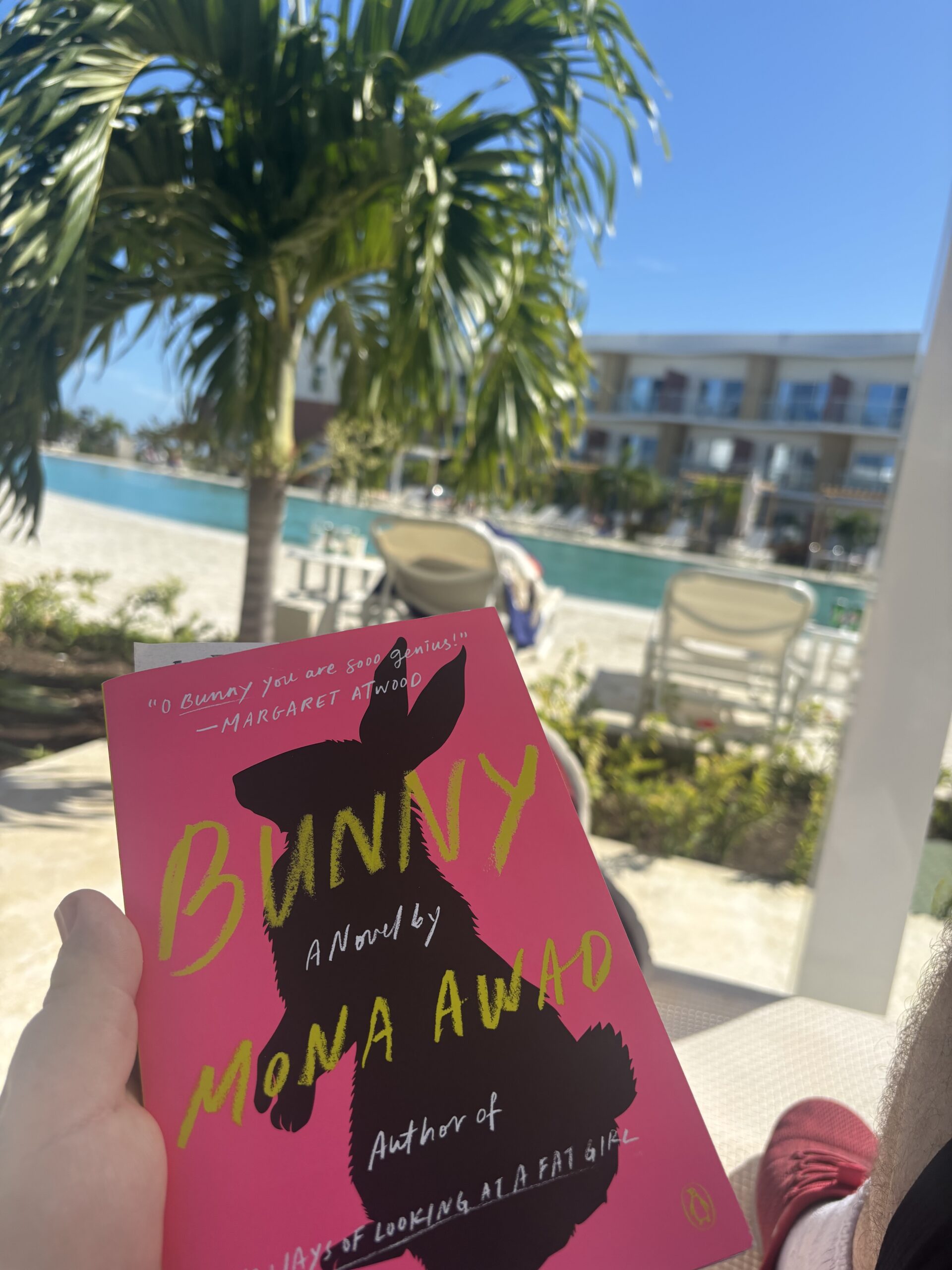
As reported yesterday, my spouse and I spent most of our time in Cuba as sick as sick dogs. The dark hours filled with coughing and night sweats were the worst. The rising sun brought some peace. We crawled out to the pool’s edge, blew our noses into napkins, and lounged. And we read books.
I’m a bibliophile, but vacation days yield more time for getting lost in books. Uninterrupted days filled with the tasty consumption of words are great days, even when you aren’t feeling your best. In today’s example of something good to read, I suggest Bunny by Mona Awad. This author was new to me, but a glance at the first few pages told me I would enjoy her wordplay. It’s reminiscent of Heathers, the 1988 movie starring Winona Ryder and Christian Slater (and 95% on Rotten Tomatoes, I might add).If you’ve ever felt like an outsider standing too close to a snooty clique, you’ll enjoy all the delicious evisceration of the in-crowd.
No spoilers. I despise spoilers.
Bunny tells the story of a young woman studying creative writing, and she’s surrounded by assholes. Anyone who has participated in a writing workshop will relate to her hatred of the worst people who show up at writing workshops. Her school has more than its fair share of fake, nasty, and cloying student writers.
Awad’s writing style is clever and hip. (Is it okay to say hip? Is that not hip? No? Okay, it’s bussin’! It’s gas! It’s buttah! Cool? Okay. Far out, groovy, and fresh!) I digress. Go read Bunny.
The keys to a great vacation are (A) not having to make decisions, and (B) a good book.Make time for reading when you aren’t on vacation, too. It’s good for your mental health.
As if mass casualties weren’t enough, 2020 just delivered another kick in the teeth. Chadwick Boseman, dead at 43 of colon cancer. His too-short career comprises much more than Black Panther, but for me, as a creator, a fan of the MCU and a comic book fan, his iconic role as T’Challah was so much more than the sum of its parts.
Hollywood underestimated the film’s saleability and impact, but Black Panther spoke to people. Wakanda is a utopian dream where everyone has dignity. Unlike the world we live in, powerful, intelligent women are not seen as a threat. Instead, they are respected. As many black people around the world have said, representation in a hugely successful franchise allowed them to feel seen for the first time.
Despite Wakanda’s monarchy, there is equality. This is best embodied in what could have been a throw-away scene in which Bruce Banner bows to the king. Chadwick Boseman delivers the line perfectly. “We don’t do that here.”
Imagine a world where someone holding power and authority asks anyone else not to bow. What a contrast to our current reality.