Psychological thrillers with underdogs facing tough odds and dark, daring twists. That’s my jamand peanut butter on sourdough bread. I hope they are your kind of fiction, too. If you like Mindhunter, you’ll love this.
Bonuses: 1. The ebook is deeply discounted for a limited time. (Also available in paperback and hardcover.) 2. You’ll find trenchant and fun conversation starters for your book club in the back. 3. There are lots of twists and turns along the way, but when will you guess the big twist?
Dr. Simon Fethullah’s weapon was his mind. It is also his torment.
As a forensic psychiatrist working with the FBI, Simon’s testimony helped to convict the Rainy Day Cannibal. After taking a bullet for his trouble, Simon retreats to the wilds of Montana to hide and to heal with his loving wife Carla and Stefano, their massive dog. The good doctor seeks peace, but murderers have long memories. When the President’s Press Secretary is assassinated, a serial killer’s dreams become our nightmares.
Though caged, prison walls cannot contain Rainy Day’s ambitions. The madman has a loyal following and a vendetta that demands a terrible price. When threatening postcards find their way to Simon’s door, it’s clear that dangerous people know how to find him, and they are coming for blood.
The Fear-Death Series features suspenseful thrillers centered on Dr. Simon Fethullah, a complex, haunted character whose love for his wife, Carla, balances him. Simon’s kind of like Dr. Gregory House, but with House hunting serial killers instead of disease. (Also, everybody loves Stefano.)
I’ve been getting lots of lovely feedback on Where the Night Takes Us. Here are a few snippets about the psychological thriller with a big twist:
It is one of those wonderful books where the reader is totally immersed in the story, unaware of their surroundings, going right along beside the characters and almost smelling the fresh brewed coffee in the story. Every part was plausible. It takes the reader through a full range of emotions which a couple of times provoked me to put the book down and digest what I’d read. This five star book is a good stand alone book but the moment I finished it I was eager for a sequel. I’m sure it will be five star too!
I got completely lost in the story. I also found myself wiping away tears and, then, a few pages later, laughing out loud at Simon’s dry, sarcastic humor. This is the first of Mr. Chute’s work that I have read, but it won’t be the last. I can’t wait to read the next in this series. I highly recommend it to fans of serial killers and psychological thrillers.
The plot twists kept me hooked throughout, whilst the suspense built chapter by chapter. Simon is a complex and realistic character, and I liked the dynamic between him and his wife in the narrative. The wild and isolated setting also added to the overall suspenseful feeling of the storyline. If this was on the tv I would have been watching it from behind a cushion!
I enjoyed the idea that the entire story was a journal and the reader was experiencing it after the fact as the character, Simon, had experienced it. Chute knows how to put little details in to have the reader go mad with questions until he finally decides to take pity and explain. Its an excellent tactic and I am here for it!
More News: The sequel is already available!
Murdered girls get headlines. Missing girls get forgotten.
A bullet drove Dr. Simon Fethullah out of the FBI. A grieving mother’s plea to find her missing daughter drags the brilliant forensic psychiatrist from his solitude. The cops blew the case, the trail’s gone cold, and Simon’s still haunted by his wife’s death. What he uncovers will test his training, his sanity, and the ghosts that refuse to let him go.
With his massive dog and a sharp-tongued driver named Paloma as his unlikely partners, he packs up his RV and heads into the Texas heat. To find the girl, Simon’s search will take him deep into the City of the Dead. When the boundary between reality and delusion blurs, Simon’s mind becomes the most dangerous terrain.
The suspense in this story is outstandingly well written. There are lovely shots of humour that provide moments of relief when things get too dark, and, as always, readers can expect unexpected developments.
This is another five-star novel from Robert Chazz Chute.
Stefano, the Cane Corso doggie says…well, nothing. He’s a dog. But if he could speak, he’d say these thrillers put movies in your head.
Every day we’re all asking the same questions about the future. Amid rampant pessimism, what is the root of all our problems, and what happens next?
Will AI empty our bank accounts and spell our doom in its own impenetrable code? What madness is this? Are we spiraling ever further down a misinformation maelstrom that denies science, lies about reality, and defies logic? When is a war not a war? If humans are basically good, how is it that so many believe that might makes right? If the pendulum of politics swings back and forth, when’s the revolution, and what will our daily lives look like when the smoke clears? Are there better days ahead? Is that even possible now?
For years, we turned our technology off and on to reboot it. Now technology is rebooting us.
When a mysterious signal circles the globe, Deborah Goodwin’s Drone Life is over. Many results are lethal. Some are hopeful. What happens next depends on the survivors.
If you loved Station Eleven or you’re curious about artificial intelligence bringing about the end of the world as we know it, this short story is for you.
I’ve been reading a lot of shorter fiction lately. Better Days Ahead is a short story I had on the back burner. I recently revisited it, made some additions, tweaks, and edits and decided to publish it on Amazon. As I write this, it sits at #44 on the 30-minute Science Fiction & Fantasy Short Reads list. (At 99 cents, it would be cheap entertainment at twice the price, so enjoy!)
And now, back to the news/circus
In high school, my social studies teacher thought my worldview was too grim. When I pointed out my reasons, she said, “You have to have faith!” To which I replied, “Why?”
I’m still asking why. True, the privileged enjoy wonders once only dreamed of in science fiction. The cell phone in your hand is a miracle packed full of the world’s knowledge. Unfortunately, that same technology arrives with a dull thud in the thick skulls of hostile apes. Steven Pinker and Bill Maher can assert all they want that there is no better time to live than now. Sure, if you aren’t in Gaza. I’m not in love with how good we have it. My focus is on how much better we could be.
One of my favorite bits from This Plague of Daysis, “You’re still fighting the wrong war.” Currently, the United States is waging three wars (four, if you count the economic war on Canada; more if you take into account piracy and other incursions.) But, you see, it’s incredibly expensive to stop Iran from having the nuclear program it didn’t have that Trump repeatedly asserts he’s already destroyed.
The president says the country is rich, rich, rich! But somehow, the US is the only industrialized nation that cannot guarantee healthcare for its citizens. Cancer and heart disease are Americans’ highest threats, but the budget is for bombs.
“But socialism and communism!” If those words make you think of totalitarianism and long bread lines instead of, say, Nordic countries with peaceful mixed economies where tax dollars are used to care for citizens, let’s save some time. Shut the fuck up.
How will it all end?
In 2018, I published a collection of short stories about several ways the world might go poof. Killer meteors, nukes, and pandemics, oh my! In those stories, I did not depict scenarios where big problems get solved. Instead, I focused on individuals facing the end. When you’re in a military bunker in Colorado and the pressure wave from a big meteor strike is rushing your way, how do you react? Or suppose the end of the world is lasting longer than that. How do you get along with your fellow would-be survivors in tight spaces underground? When do the murders begin?
Imagining the future in the abstract is interesting and fun. The timeline could have many branches, but let’s break it down to three basics:
1. Dystopian AKA The Star Wars Future. You can tell because many of the spaceships aren’t in great condition. Having Wars in the title is another hint. 2. Utopian AKA The Star Trek Future. There are still wars, but the main mission is exploration and expanding knowledge. Also note that the spaceships are super spiffy! 3. Apocalyptic. We follow the path that has been trod before: Extinction.
But how do we get to better days ahead?
We address the root of all our problems. What’s that? Our addiction to the circus. It’s not looking great on several fronts at the moment, but politics could be how problems get solved. Comedian Jimmy Carr once said that debate solves nothing. His answer is not debate, but deliberation.
That shift from Me to We flips the spirit of the work entirely. Actual good work might get accomplished if we don’t go at it as if we’re stepping into the ring. Of course, that’s not the current zeitgeist at all.
We suffer an infection of contrarians and sophists.
Sometimes I wonder if there is anything some people won’t say. RFK Jr. is still spouting conspiracy theories about chemtrails.
JD Vance muses about UAPs being demons, and paraphrasing, “I try to do God’s work, but if it leads to the End of Days, well, okay.”
Donald Trump insists prices are coming down, the war is won (more than 100 times), and everybody loves him, and everybody knows it. Ignore the polls, your lying eyeds, and anyone who criticizes him is a threat to national security and his massive insecurity.
Don’tcha miss when politics was boring? Instead, people who care less about other people treat politics, not as a way out, but as bloodsport. People who think they’re good and righteous practice casual cruelty and blatant racism. Children are suffering, but “well, okay.”
The root of all our problems is found in a Peanuts cartoon.
Lucy’s doing her underpaid and unlicensed psychologist bit on Charlie Brown.
“Do you know what your problem is?” she shouts.
“Your problem is you don’t want to hear what your problem is!”
And there it is: The first step out of addiction is admitting we have a problem.
We can’t begin to solve any problems if we can’t even agree on what the problems are. To veer away from disaster, we must acknowledge our addiction to the circus. Aggression gets clicks. Name-calling has replaced elucidation, deliberation, and problem-solving. To combat decay, regression, and extinction, we need sober and boring.
Or we could listen to the Ringmaster shrieking, “Eyes on the center ring! The world’s circus features monkeys with machine guns!”
Sure, there are great people pursuing solutions and working on the cure for terrible diseases. I just wish they weren’t so outnumbered. This is why I still don’t have faith. Reality as it now stands sucks, but at least there’s still fiction that knows it’s fiction.
Reviewed in the United States on September 19, 2026
(reviewed on Amazon by Teresa Collins)
Where the Night Takes Us is an excellent serial killer/psychological thriller that lingers for days after you turn the last page. It will take up bandwidth in your brain and just make itself at home. The characters are so intriguing and realistic that they feel like real people. The story is engrossing, and I found myself reading much longer than I should have, but I couldn’t put it down.
Mr. Chute’s writing flows so smoothly and is so easy to read that I got completely lost in the story. I also found myself wiping away tears and, then, a few pages later, laughing out loud at Simon’s dry, sarcastic humor. This is the first of Mr. Chute’s work that I have read, but it won’t be the last. I can’t wait to read the next in this series. I highly recommend it to fans of serial killers and psychological thrillers. I received a review copy from the author via BookSirens, and this review reflects my honest and voluntary opinion.
~ I’m Robert Chazz Chute, the suspense novelist who writes apocalyptic epics with heart and crime thrillers with muscle. Please allow me to put visions in your brain box.
I have to admit, this soft launch is a bit unexpected. The novel is fully edited and ready (thanks again, Gari and Russ!), but I had planned to wait a little longer. Getting the Bookbub campaign changed that strategy. A lot of people will get the link to the first book in the series on Tuesday for just 99 cents. I’m hoping that offering the sequel now will encourage more readers to follow Dr. Simon Fethullah into his next investigation. I’ll do more of a marketing push once more reviews come in and things progress.
The Premise
In When the Night Finds Us, a grieving mother pleads with our not-so-intrepid forensic psychiatrist to find her missing daughter. The game’s afoot! With his massive dog and a sharp-tongued driver named Paloma beside him, Simon climbs into his new RV and heads into the Texas heat to find Wilhelmina Dupree, dead or alive. I love how Simon solves this mystery, but for me, the banter between the good doctor and Paloma is the most fun.
If you think the novel might appeal to someone who enjoys psychological thrillers, missing-person mysteries, or dark, character-driven crime fiction, I’d be grateful if you shared it with them. Even a quick mention, a social post, or a review from anyone who reads it would help more than you know.
I’m worried about literacy. We don’t have enough of it. Too many people either don’t read, obsess over social media, or scan summaries instead of experiencing the immersion of pulling a book and getting movies in their minds. Fewer people make the time or have the patience to enjoy a book, and that’s bad for our brains. It’s bad for all of us.
I’m going to recommend three books. (I wrote two of them.)
One of books I’m enjoying recently is Anthony Hopkins ‘ autobiography, We Did OK, Kid. (If you listen to the audiobook, Kenneth Brannaugh narrates, and his voice work is, as you’d expect, excellent.) Hopkins reminded me of his role in 84 Charing CrossRoad. Last night, I ran across the book and I bought it immediately.
This slim volume is an ode to a bygone time when books were valued so much more by many more people. It’s an epistolary story wherein a very literate and funny woman in New York has a back-and-forth with a bookseller in London, England. Beginning in 1949, she requests used books only they can procure to her satisfaction. If you love books, you’ll love the movie and the book.
As soon as I found it at the bookstore, I had to buy a latte and dig in immediately. It’s a funny, plotless book with an unambitious premise. It’s not about dark forces taking over the galaxy. It’s just letters back and forth by bibliophiles who, incidentally, will never meet in person.
And to be honest, I choked up a little. 84 Charing Cross Road takes place in hard times. It’s a time I never lived in, yet I’m nostalgic for: A time when more people loved books, discussed books, and fiction and non-fiction were more centered in the culture. Your phone is full of vitriol. Push back on the brain rot. Reject rage bait that seeks to anger you for clicks. Choose media that informs, entertains, and enriches.
How do we fight forces pushing literacy down? Read books. Make it normal to discuss books. Review books. Support authors. Join a book club. Don’t fall for censorship. Read banned books. Frequent your local library and little libraries. Read to your kids. Put down the phone more and pick up books instead. Make reading ubiquitous again. I don’t know how much we’ll improve literacy, but at least we can try to hold the line and not let reading fall by the wayside completely.
The next book I recommend is mine, and it’s on sale now.
Dr. Simon Fethullah was the FBI profiler who put the Rainy Day Cannibal away. The cannibal’s back, and the madman coming for Simon and his family. Find out more about the plot here.
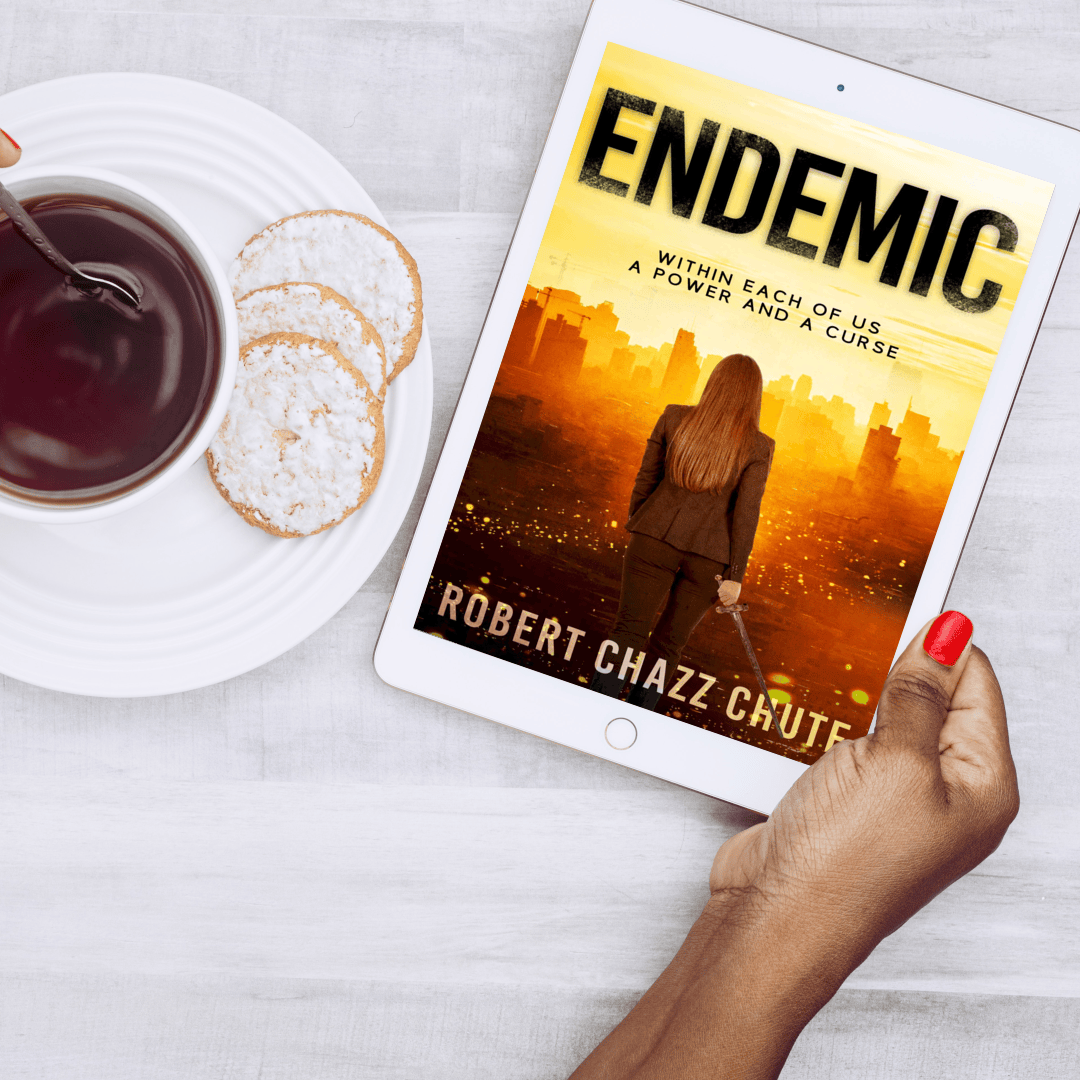
I have entered Endemic for the Booklife Prize. Endemic won the North Street Book Prize in 2022, so I’m hopeful. Part of the deal is that I received a review from a Booklife critic. Here’s what they had to say:
Title: Endemic Author: Robert Chazz Chute Genre: Fiction/Sci-Fi/Fantasy/Horror Audience: Adult Word Count: 99876
Assessment:
Plot: Set in a post-apocalyptic world, Robert Chazz Chute’s science fiction follows Ovid as she navigates a transformed society and searches for her place within it. Chute creates a believable setting that gives the story a strong sense of possibility and danger. Fans of apocalyptic fiction and detailed world-building will find much to enjoy.
Prose: Robert Chazz Chute opens in medias res, with Ovid on the streets of New York after a virus has ravaged the city and much of the world. For anyone who lived through COVID-19, the premise carries an unsettling echo of reality: a city under lockdown that emerges permanently changed. Chute’s vivid descriptions give this altered world a strong sense of place, while its specialized jargon reflects the communities that have formed without leaving readers struggling to understand them.
Originality: Chute gives the story its own identity through its attention to group dynamics and the communities that emerge after disaster. Its vision of a world that remains recognizable yet has been permanently altered makes Endemic a strong addition to post-apocalyptic science fiction.
Character Execution: For fans of science fiction and end-of-the-world stories, much of the appeal lies in seeing how people adapt when the rules of ordinary life disappear. Chute portrays the community Ovid must navigate with impressive detail, while making her survival something readers will genuinely root for. Her encounters and conflicts with the people around her reveal how this new world is changing her, making Ovid a memorable protagonist.
~ Thanks for being a reader! I’m Robert Chazz Chute, the suspense writer who works from a blanket fort in Other London. It would help me immensely if you let me entertain you. Enjoy my books for hours of twisty fun. Books make great gifts, so buy in bulk. 😉
For readers who love forensic minds, damaged heroes, dastardly villains, isolated settings, and the kind of suspense that makes you check the locks twice. Where the Night Takes Usis waiting in the darkness. I hope you’ll find it the best psychological thriller you’ve read in a long time.
What do you want to know about my new suspense novel?
There is a particular kind of fear at the heart of psychological thrillers: the fear that escape is an illusion.
In Where the Night Takes Us, Dr. Simon Fethullah tries to step away from the violent world he knows. As a forensic psychiatrist working with the FBI, he used his expertise to understand dangerous minds. Simon’s testimony helped convict the Rainy Day Cannibal, but the victory came at a terrible cost. After taking a bullet, Simon retreats to Montana with his wife, Carla, and their enormous dog, Stefano.
Montana seems like the perfect place to begin again. But can physical isolation ever provide emotional safety? Simon is far from the courtroom and the FBI, but he is not free from memory. The people he studied — and the consequences of helping put them away — haunt him. This thriller explores the weaponization of knowledge. Simon’s mind made him valuable in the fight against criminals, but it is also his torment. Knowledge offers little comfort when it confirms your worst fears.
The big bad is the Rainy Day Cannibal. Though in prison, he is not powerless. His loyal followers have become eager accomplices. A prison cell may hold a body, but it cannot necessarily contain an idea or curb a vendetta.
For readers drawn to stories about damaged minds, moral uncertainty, and the long shadow of violence, Where the Night Takes Us offers unsettling questions: Are you safe? Is anyone? And what are you willing to do when danger comes knocking on your front door?
It begins with a threatening postcard from a serial killer. Before it’s over, the US press secretary will be assassinated, a girl is kidnapped, and the good guy must cover up a murder.
Dr. Simon Fethullah is the FBI profiler who put away the Rainy Day Cannibal. Rainy Day is in prison, but he’s still coming after the good doctor. Hiding in the remote woods of Montana won’t be enough to save Simon and his wife. Stalked and alone, they’ll have to defend themselves from monstrous strangers. Serial killers don’t give up easily.
(Also, you’re going to fall in love with Stefano, but you’ll have to read the novel to find out what he’s all about.)
Where the Night Takes Us releases on September 14, but the ebook is available for pre-order at a steep discount.
It’s sneak peek time! My new novel, Where the Night Takes Us, releases September 14! This post includes this thriller’s sales blurb, a reading sample, pre-order links, details on the special release price, and availability.
What’s it about, Rob?
Dr. Simon Fethullah’s weapon was his mind. It is also his torment.
As a forensic psychiatrist working with the FBI, Simon’s testimony helped to convict the Rainy Day Cannibal. After taking a bullet for his trouble, Simon retreats to the wilds of Montana to hide and to heal with his loving wife Carla and Stefano, their massive dog. Simon seeks peace, but murderers have long memories.
When the President’s press secretary is assassinated, a serial killer’s dreams become our nightmares. Though caged, prison walls cannot contain Rainy Day’s ambitions. The madman has a loyal following and a vendetta that demands a terrible price. When threatening postcards find their way to Simon’s door, it’s clear that dangerous people know how to find the good doctor, and they are coming for blood.
Not sure yet? Okay, try the reading sample and see if you’re hooked. The novel opens like this:
Proviso
There is a body buried in the woods behind my house. He lies in the grave he deserves, unmarked and — as far as I know — unmissed. To me, writing is a compulsion. At some point, I will record the details of my crimes.
If nothing dire happens to my wife or me, no one will ever read these words.
You’re Not Stephen King
Life is a jumble of variables. Countless twists, turns, and tangents lead us to each moment. It is impossible to pin down any one solitary event as the beginning of things. The chain of events that led me to drink this morning’s bitter coffee from my favorite chipped mug can be traced back eons to the mysteries of the Big Bang. Since the universe exploded into existence, evolution branched in certain ways. Some extinction events occurred, and perhaps miraculously, others did not. That seemingly random chain of events only becomes a sensible chain of evidence in retrospect. So, picking a beginning at random, I’ll start with the first postcard. It arrived last winter.
With trembling hands, I held a manila envelope, thick and battered from abuse it had suffered in transit. The return address told me this was mail forwarded through my publisher. I stood frozen on the side of the road beside my battered old mailbox and muttered a few choice curses as if words were spells that could keep the bogeyman at bay.
Spring seemed a far-off promise, and a thick blanket of white drifts reached up to my knees. The air was still. Not even the birds sang. It was as if all of nature held its breath, waiting and watching. Snow so quieted the music of the world that I imagined how lonely it must be to be deaf.
To my right, my neighbor’s long driveway was unplowed. Their farmhouse appeared deserted and lonely. I strained to listen for any hint of human activity, but Mercury County, Montana, was as silent as a tomb. Nonetheless, I couldn’t shake the feeling that someone was surveilling me to gauge my reaction to the envelope in my hand. I imagined a faceless stranger targeting me through a rifle scope.
“Get a grip, Simon,” I told myself. “Stalkers are rarely serious threats, especially when they announce themselves but still hide behind anonymity. The real ones just come and shoot you in the face in person.”
I used to get mail from my literary agent and Ex Parte Press more frequently. After three books, though, the checks shrank, and the correspondence became less frequent. When my book sales were significant, I was excited to receive any missive from my agent, Caison Willoughby, or Holly Papandreas, an editorial assistant at Ex Parte Press. Since an anonymous stranger began getting to me through my publisher, dread consumed me as I approached my mailbox.
Before I even retired from the FBI, I’d been careful to scrub any online presence that might leak my contact information. Forwarded mail from my publisher was really the only way dangerous strangers could slither into my life. Holly sent me rare fan letters or clips of fresh book reviews. Each year, I received a couple of invitations to literary conferences (flattering, but I’d never go).
Once in a while, a murder victim’s family or a criminal lawyer would ask me to get involved in a cold case. Pleas for my expertise fed my ego, but I always replied that I was retired. Forensic psychiatrists are at high risk for early burnout. That’s what got me after what happened in Dallas.
In my replies, I made an effort to sound encouraging. Victims’ families don’t need brutal honesty. I told them the professionals assigned to their cases would no doubt keep their dead loved ones top of mind. That wasn’t true, of course. Officially, law enforcement never gives up on homicides. However, roughly half of all murders in the United States go unsolved. Fresh corpses demand new energy. Old case files moulder like bodies in forgotten graves.
Postcards from the anonymous sender came at long intervals but ruined all my trips to the mailbox. The editorial assistant never saw the postcards she forwarded to me. They all arrived in a sealed envelope marked personal. Each envelope was indistinguishable from the others. The front of the first postcard was a picture of downtown Albuquerque.
That first missive wasn’t even a threat. The message was just one word:
Apologize!
A vague command scrawled in bright red ink. No explanation. I’d spoken to a lot of unhinged people over the years, and not all of them were incarcerated. Standing in the snow as the cold seeped through my boots that morning, I pondered the message.
Which maniac demanded my attention? And red ink!Did that imply a debt I owed? Or was it meant to signify blood? Or was I overthinking again?
My wife, Carla, was sanguine about the first postcard. “It’s one thing to go to the bother of putting a postcard in an envelope to pop it in the mail,” she told me. “It’s quite another to actually track you down out here in the woods. Success pulls attention from people who don’t have it. That’s all this is.”
“It’s true that attention attracts resentful crazies,” I conceded. “Before Mark David Chapman murdered John Lennon, he considered killing Stephen King. Did you know there was a stalker who broke into King’s home in Maine and threatened to blow up the place?”
Carla said softly, “You’re one of the good guys, but you’re not Stephen King, darling.”
She was right, of course. As a writer, my success was modest. I’d emailed my best friend and old partner, Agent Denise Absing, that my first book had sold enough to get a second printing. In her inimitable way, Denise brought me down to Earth. When I picked up the phone, she began with, “Hey, Can Opener! Got a question for ya!”
“I’m bracing for impact,” I replied.
“Can you still squeeze your head through doorways? I wouldn’t get too big a melon if I were you. Your book’s awfully long.”
“Maybe my customers are stacking them up against walls for insulation?” I suggested.
“That makes more sense. No one reads anymore, Si! That’s what makes this second print run of yours an even greater achievement!”
“And a complete mystery to you?” I prodded.
“I mean, I’ll get around to reading it, but I have to. As a friend, it’s an obligation.”
“It’s so gratifying to hear that I’ve assigned you homework. Can’t fool me, though. You’ll read it cover to cover to see how many times your name gets mentioned.”
“Actually, I was hoping there’s an index.”
Denise’s laugh sounded something like the barking of a seal combined with a new driver grinding gears. When she was done roasting me, she added, “I’m assuming that any mention of my name is paired with laudatory phrases. ‘Mercurial wisdom’ would be good.”
“You surprise me, Denise. I didn’t know you could read.”
My friend’s teasing aside, after publishing my first book, I thought I’d made it. Serial Killers I Have Known spent two weeks on The New York Times Best Sellers list (#10, but still), a laudatory review in Publishers Weekly, and a nice mention in an article in The Atlantic.
Starting out, my expectations for a second career in creative non-fiction were high. Once, when a barber asked what I did for a living, he got excited. “Would I have read anything you’ve published?”
Flattered, but also self-aware enough to be self-deprecating, I answered, “If you’re incredibly well-read, maybe?”
“What’s your name? You famous?”
“Simon Fethullah,” I said, “but I’m only famous in small circles.”
The barber’s excitement proved brief. “Never heard of you.”
“I’m crushed,” I said. “This is why I prefer barbers who don’t speak my language.” I left him a large tip for reasons I can’t now fathom and never returned to that barbershop.
To me, succeeding as a writer meant I could finally have the solitude I craved. I fantasized about the happy life of a hermit. Once every year or two, I’d venture out into the real world. I’d fulfill my contractual obligations at a book launch followed by a bunch of bookstore signings across the country. I held on to those delusions of grandeur right through to the release of the third book, Monsters in Human Masks.
My first hint that things were going sour was that Ex Parte Press had no budget for a book tour. Prodding them for book marketing plans, the editorial board replied rarely, slowly, and tentatively. My editor, Amira Coldstaad, said, “We’ll see,” a lot.
Confirmation of my failure came when my editor refused to take my calls. She pawned me off on Holly Papandreas. The editorial assistant was kind, quick to answer my calls and emails, and utterly useless in aiding my cause. In the end, all she did for me was forward the damnable mail from the anonymous sender.
The second stage of my downward spiral came when a crazed woman shot me in Dallas. I survived but got a hip replacement for my trouble. Depressed, my spiral downward continued at greater speed. A medical leave turned into my retirement.
Perhaps you read about the shooting? The Huffington Post ran with the headline, “Forensic Psychiatrist Shot in Courtroom Melee!” USA Today went with, “The Rainy Day Cannibal Gets His Revenge!” Tucker Carlson took my near-death experience as an opportunity to reinforce the idea that the nation was falling apart. His commentary was trite and he mispronounced my name, but otherwise I wasn’t in a mood to disagree.
What Carla referred to as my “JFK moment” occasioned a brief resurgence of interest in my work. Getting shot in Dallas and admiring Marilyn Monroe were all I had in common with the assassinated president. That was more than enough overlap for me. I’d rather have kept our commonalities to our interest in Marilyn in Some Like It Hot.
Winston Churchill once said something about how there was nothing more exhilarating than getting shot at. That is so, as long as they miss. At the time, we assumed Roderick Shane’s sister was aiming for the prosecutor. Missed him, got me.
Only the Rainy Day Cannibal knew how vast and deep his plots were to become. Long after I quit the FBI and he was behind bars, Roderick Shane’s machinations set the United States on fire.
Please note: If you pre-order now, you’ll receive the debut novel in the Fear-death Experiences Series for only 99 cents. (This special discount for pre-orders will only stand for a limited time. After a week, the e-book price will rise to $4.99.
Best practice: Lock in your discount price now with the pre-order.
Where the Night Takes Us will be exclusive to Amazon for three months as an e-book and in paperback. The hardcover will be released on November 1. After three months, distribution will go wide to all sales platforms.
~ I’m Robert Chazz Chute. I write crime thrillers with muscle and apocalyptic epics with heart. Best known for This Plague of Days, I’ve won fifteen awards for my writing. The sequel to Where the Night Takes Us is When the Night Finds Us, and it is in production. Please subscribe for updates, and happy reading!
Can’t wait and want a summer beach read now? I got you. Here’s another novel with a faithful dog as a sidekick.
“You’re guaranteed a mighty fine read.” ~ Claude Bouchard, USA Today Bestselling author of the Vigilante Series.
Easy Jack isn’t a bad guy, but to survive, he will have to act like one.
Returning home after serving his country, Ernest “Easy” Jack hoped his family’s reputation had been forgotten. No such luck in Lake Orion. Small towns have long memories. Grudges run deep. Worse, his high school sweetheart is trapped in an abusive marriage. Family bonds, love, and loyalty will be tested when a sociopathic billionaire and a dirty cop conspire to use Easy in a deadly bomb plot. Escape is unlikely. Easy’s odds are not even.